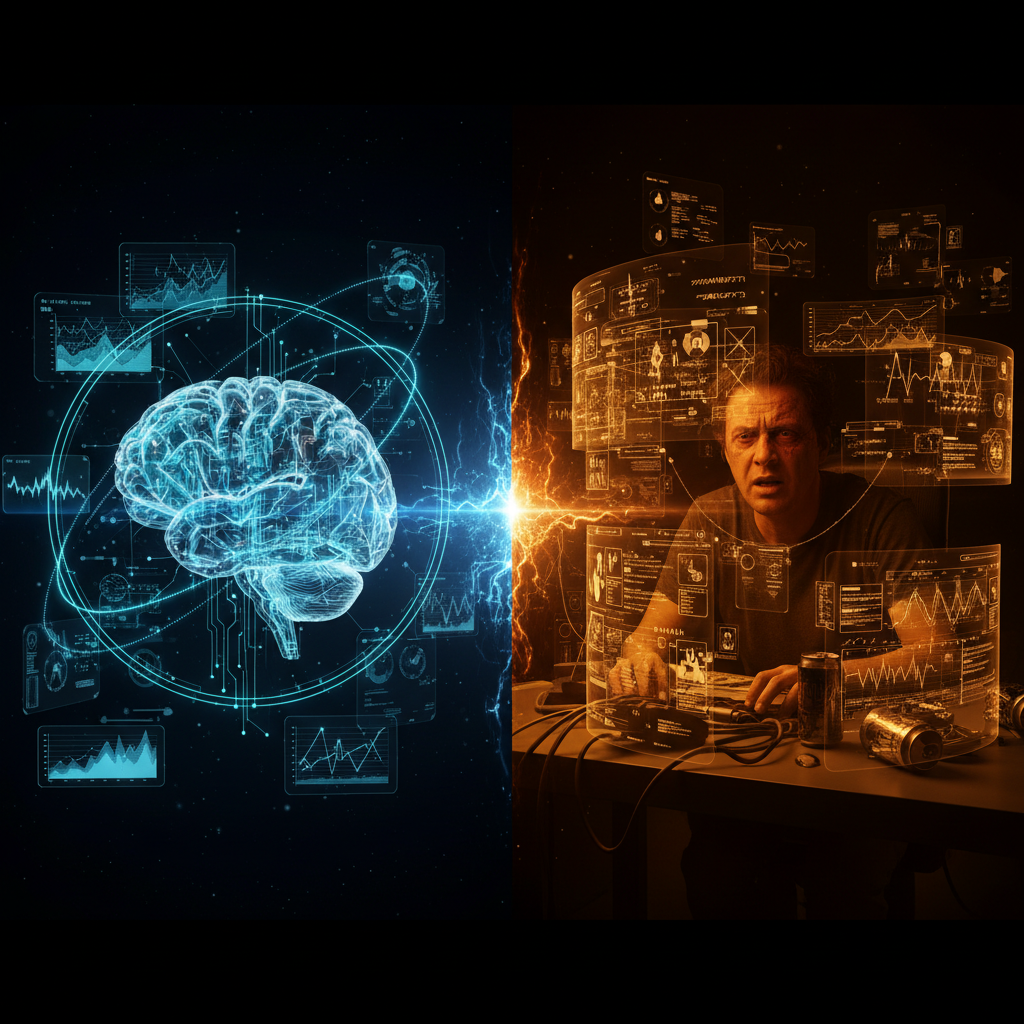
The Human Side of Agentic Systems: Why the Agent Industry Is Designing for Machines, Not People
Part 4 of 6 | By Tamil Selvan Gunasekaran, AI Agent Developer Intern at Autohive & HCI Researcher
The Uncomfortable Question Nobody Is Asking
I spend my days in two worlds. In one, I am a PhD researcher at the Empathic Computing Lab, studying how humans think, collaborate, and make decisions when AI enters the room. In the other, I am an AI Agent Developer Intern at Autohive, a startup building a production platform where AI agents handle real work for real businesses.
What bothered me early on was how rarely these two worlds talk to each other.
The agent industry is in a performance arms race. Every week there is a new benchmark, a new model, a new framework promising better tool-calling accuracy or lower latency. We measure cost-per-token to six decimal places. We build evaluation arenas that score models across dozens of dimensions. We obsess over whether Claude beats GPT-4o on reasoning tasks.
And in all of this, we keep flattening the human into a checkbox.
Not the phrase "human-in-the-loop" that shows up in diagrams. I mean the actual person staring at the dashboard, reviewing outputs, trying to decide if the agent is right, and slowly getting mentally cooked by the interface around them. That person has limits. Attention limits. Trust limits. Decision limits. Most agent systems are designed as if none of that matters.
I have spent years studying what happens when humans collaborate with AI. The thing I keep seeing is this: the industry optimizes agent performance and then acts surprised when the human experience is terrible.
The first three posts in this series were about architecture, monitoring, and evaluation. This one is about the part we keep under-designing: the human who has to live with those systems.
1. Cognitive Load Is the Real Bottleneck
One of the most useful things HCI taught me is embarrassingly easy to forget in engineering: human attention is finite. Every extra panel, trace, alert, and paragraph costs something.
Cognitive Load Theory has massive implications for agent design. Recent research from MIT Media Lab (Kosmyna et al., 2025) demonstrated that heavy AI assistant use leads to measurable "cognitive debt" — reduced neural connectivity and diminished independent thinking. A separate study of 666 participants (Abbas et al., 2025) found a strong positive correlation (r = 0.72) between AI tool use and cognitive offloading, meaning the more people rely on AI outputs, the less they engage their own critical thinking. The core idea is simple:
- Intrinsic load: The inherent complexity of the task itself
- Extraneous load: Complexity added by bad design — irrelevant information, poor formatting, unclear structure
- Germane load: The mental effort spent on actually learning and making decisions
Total Cognitive Load = Intrinsic + Extraneous + Germane

If Total > Working Memory Capacity → Failure
Working memory can hold roughly 4 ± 1 chunks of information at a time. Not 20. Not 50. Four. The 2026 World Economic Forum report "The Human Advantage: Stronger Brains in the Age of AI" warns that without deliberate investment in human cognitive capacity, AI-augmented workplaces risk "driving preventable costs through declining employee well-being."
Now think about what a typical agent dashboard looks like. An operator monitoring five agents sees: conversation logs, tool call traces, error rates, token usage, cost breakdowns, evaluation scores, real-time status updates, approval requests, and escalation queues. All at once. All competing for four slots in working memory.
When I look at most agent dashboards, I do not see a monitoring problem first. I see a cognitive load problem.
| What Agent Platforms Do | What They Should Do | HCI Principle |
|---|---|---|
| Show all metrics simultaneously | Show only actionable metrics; hide the rest | Reduce extraneous load |
| Display raw conversation logs | Surface decision points and anomalies | Information scent (Pirolli, 2007) |
| Alert on every threshold breach | Aggregate related alerts into incidents | Chunking (Miller, 1956) |
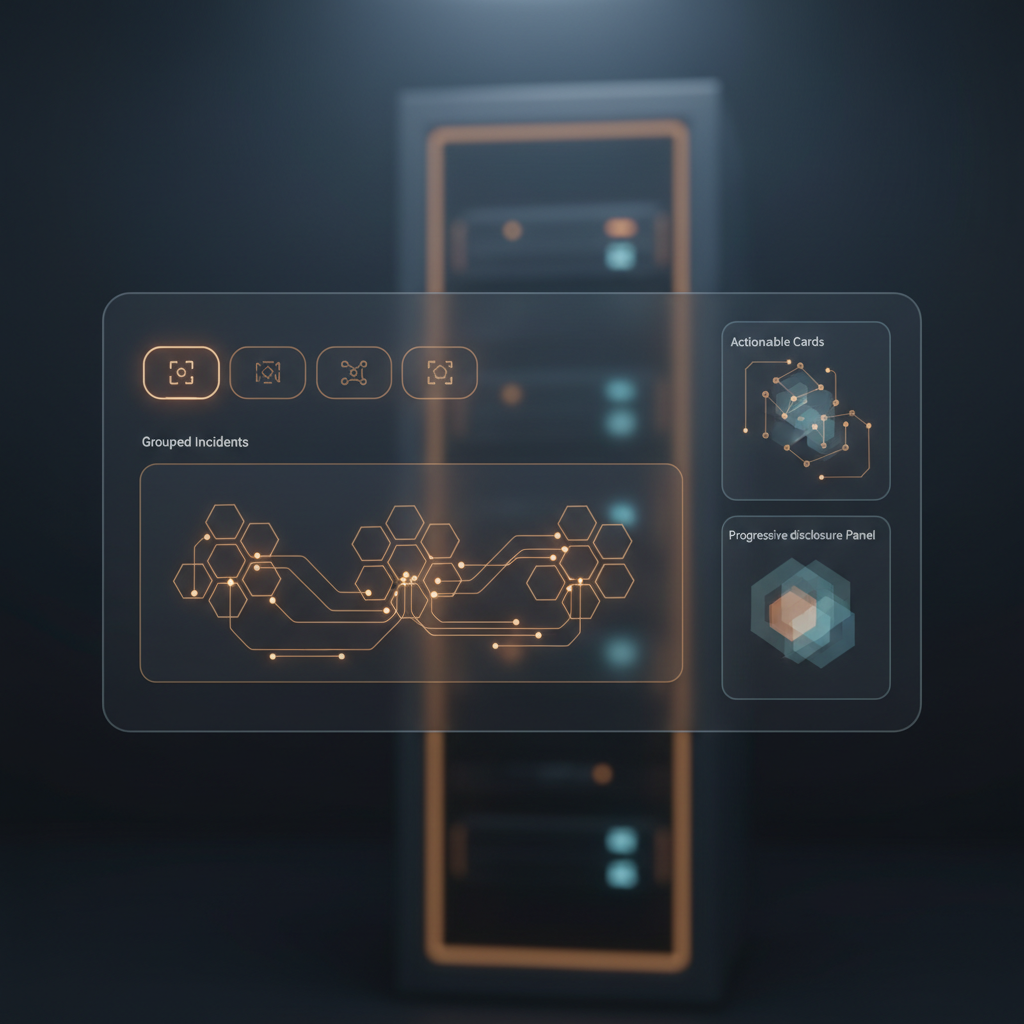
| Present 10-field approval forms | Ask one question: "Approve this action? Here is why." | Progressive disclosure |
| Render tool call traces as flat lists | Show traces as collapsible hierarchies | Visual hierarchy |
The agent industry treats human attention as infinite. Cognitive science proved it is not — fifty years ago.
The Formula Nobody Uses
The way I make this practical is by treating each output as having a cognitive cost:
CognitiveCost(output) = InformationDensity × DecisionComplexity × ContextSwitchPenalty

where:
  InformationDensity  = words + data_points + visual_elements
  DecisionComplexity  = number_of_options × uncertainty_level
  ContextSwitchPenalty = 1.0 if same_task, 2.5 if different_task
Most agent systems maximize InformationDensity ("give the user everything, let them figure it out") while ignoring that ContextSwitchPenalty alone can more than double the cognitive cost. An operator switching between a support agent and a data extraction agent is not just reading two outputs — they are rebuilding their entire mental model each time.
2. The Second-Order Outage: When Agents Work Too Well
Everyone in this industry is focused on making agents succeed. Almost nobody is thinking about what happens when they succeed at scale.
The scenario looks like this. You deploy five agents. Individually, they all look successful. Together, they generate a flood of output that humans still need to review, approve, or absorb.
I call this the second-order outage — the system is working perfectly, but the humans operating it have collapsed.
Work inflation is the mechanism. Every competent agent generates downstream work for humans:
- Support agent resolves 200 tickets/day → someone needs to quality-check a sample
- Data agent produces 15 analysis reports/day → someone needs to read and act on them
- Coding agent opens 30 PRs/week → someone needs to review them
- Scheduling agent books 40 meetings/week → someone needs to attend them
ReviewLoad = Σ (AgentOutput_i × ReviewRate_i × TimePerReview_i)

If ReviewLoad > AvailableHumanHours → Second-Order Outage
The math is unforgiving. If each agent output takes 3 minutes of human review and you have five agents producing 50 outputs per day each, that is 250 × 3 = 750 minutes of review work per day. That is 12.5 hours. For one person. Every day.
Queueing Theory Meets Human Limits
Little's Law from queueing theory gives us the relationship:
L = λ × W

where:
  L = average number of items in the review queue
  λ = arrival rate (agent outputs per hour)
  W = average time to process one item
If agents produce 30 items per hour and a human takes 4 minutes per item, the human's throughput is 15 items per hour. The queue grows at 15 items per hour. By end of day, there are 120 unreviewed items. By Friday, the system is drowning.
Your agent platform's job is not to generate output. It is to protect your humans from output.
Designing for Throughput Sustainability
The fix is not "hire more reviewers." The fix is designing agent output for minimal human processing time:
- Decision-ready artifacts: Do not give humans raw data. Give them a recommendation, a risk summary, and a one-click action. Reduce W in Little's Law.
- Confidence gating: Only route to humans when the agent's confidence is below a threshold. Reduce λ.
- Batch decisions: Group similar items. "These 12 support responses all follow the same pattern — approve all?" Reduce L through chunking.
- Output shaping: Force agents to emit structured, scannable outputs — not verbose explorations.
3. The Attention Economy Inside Your Agent Platform
Research consistently shows that human working memory holds about four items at a time. Jakob Nielsen and the Nielsen Norman Group have spent three decades proving that people do not read — they scan.
None of this research has penetrated the agent industry.
Put plainly: token costs are rounding error. Human attention is the expensive resource.
A GPT-4o call costs fractions of a cent. The engineer who reads the output, decides whether to trust it, and takes action on it costs $80-200 per hour. Every minute of unnecessary cognitive effort is real money — far more than the tokens that generated it.
An Attention Budget
I propose treating human attention as a first-class resource with an explicit budget:
AttentionBudget(team) = TeamSize × FocusHoursPerDay × AttentionUnitsPerHour

AttentionCost(agent_output) = ReadTime + ComprehensionTime + DecisionTime + ActionTime

Daily Attention Spend = Σ AttentionCost(all_agent_outputs)

If Daily Attention Spend > AttentionBudget → Overload| Attention Cost Factor | Low Cost | High Cost | Design Lever |
|---|---|---|---|
| ReadTime | Structured, scannable | Wall of prose | Format + hierarchy |
| ComprehensionTime | Familiar patterns | Novel format every time | Consistency |
| DecisionTime | Binary choice with context | Open-ended with ambiguity | Confidence scores + recommendations |
| ActionTime | One-click action | Multi-step manual process | Automation of the last mile |
Information Scent
Information Foraging Theory explains how humans navigate information environments. People follow "information scent" — cues that suggest relevant content is nearby. Strong scent means they find what they need quickly. Weak scent means they wander. Chen et al. (2025) describe how the new agent interaction paradigm demands that AI outputs be designed for human "cognitive strain alleviation" — yet most agent frameworks still dump raw outputs and expect the user to forage.
Agent outputs with weak information scent look like this:
- Long paragraphs with no headers
- Buried conclusions
- Technical details before the summary
- No visual distinction between critical and incidental information
Agent outputs with strong information scent:
- Status first (success/failure/needs review)
- Summary in one sentence
- Recommendation with confidence level
- Details collapsed, expandable on demand
Design agent outputs like newspaper articles: headline first, lead paragraph second, details third. The reader should be able to stop at any point and still have the most important information.
4. Trust Is Not a Toggle
Most agent platforms treat trust as a binary. The agent either has permission to act autonomously, or it requires approval. On or off. Trusted or not.
This is a fundamental misunderstanding of how humans actually trust.
McGrath et al. (2025) introduced the CHAI-T framework (Collaborative Human-AI Trust) specifically for human-AI teaming contexts. Their key insight: trust in AI collaboration is not a static property — it is a dynamic process that evolves through team interaction phases, influenced by task context, performance history, and environmental factors. Gerlich (2024) further showed that trust in AI is driven by a complex interplay of motivators where familiarity and perceived competence shift the balance — meaning trust is a continuous variable that evolves with experience, not a setting you configure.
The Trust Spectrum
Blind Trust ←——————— Calibrated Trust ———————→ No Trust
(dangerous) (ideal) (wasteful)- Blind trust: The user accepts everything the agent says without verification. Efficient but dangerous — one bad output and the consequences can be severe.
- Calibrated trust: The user has an accurate mental model of when the agent is reliable and when it is not. This is the goal.
- No trust: The user checks everything, effectively doing the work themselves. The agent becomes overhead, not help.
Trust calibration requires two things that most agent systems do not provide:
- Transparency: The user can see why the agent made a decision, not just what it decided
- Track record: The user has accumulated enough experience to know the agent's strengths and weaknesses
How Trust Decays
Trust does not just build — it also decays, and it decays asymmetrically:
TrustGain(success)  = small, incremental (+0.01 to +0.05)
TrustLoss(failure)  = large, sudden (-0.10 to -0.40)
TrustRecovery(time) = slow, logarithmic
One bad output can undo twenty good ones. The CHAI-T framework (McGrath et al., 2025) explicitly models this through "performance phases" where trust updates are asymmetric — negative experiences carry disproportionate weight. This has a direct implication for agent design: the cost of a single visible failure is far higher than the benefit of a single visible success.
This means:
| Design Implication | Why |
|---|---|
| Show confidence scores on every output | Users learn when to trust and when to verify |
| Highlight uncertainty, do not hide it | Transparent uncertainty builds trust; hidden uncertainty destroys it |
| Admit mistakes explicitly | "I may be wrong about this" is trust-building, not trust-destroying |
| Offer easy verification paths | Let users spot-check without derailing their workflow |
| Track trust over time per user | Different users calibrate at different rates |
Learned Helplessness
There is a darker failure mode that nobody in the agent industry discusses: learned helplessness. When an agent handles tasks that a human used to do, the human gradually loses the ability and confidence to do those tasks themselves. If the agent then fails or is unavailable, the human cannot fall back to manual execution.
This is not hypothetical. Zhai et al. (2024) found that students who heavily relied on AI dialogue systems showed diminished decision-making and critical analysis abilities. The MIT Media Lab study (Kosmyna et al., 2025) reported reduced brain connectivity and underperformance after heavy LLM reliance. That should worry anyone designing agents for knowledge work.
I do not want agents to get so frictionless that the human stops thinking. I want them to reduce operational load without switching off the user's judgment.
5. Agent Memory Rot: The Entropy Nobody Audits
Everyone celebrates long-term agent memory. "Our agents learn from every conversation. They remember your preferences. They build context over time."
Nobody talks about what happens six months later.
Agent memory is subject to entropy — the gradual accumulation of stale, contradictory, and unverified information that degrades decision quality over time. And unlike human memory, which has built-in mechanisms for forgetting irrelevant information, agent memory stores everything with equal weight. Risko and Gilbert (2024) describe this as a fundamental asymmetry in cognitive offloading: humans evolved sophisticated forgetting mechanisms that improve decision quality, but the systems we build to augment them lack any equivalent.
The Rot Taxonomy
| Memory Failure | Example | User Impact |
|---|---|---|
| Stale facts | "Customer prefers email" — they switched to Slack 3 months ago | Agent uses wrong channel, user corrects, trust decays |
| Contradictions | Memory A says "budget is $50k", Memory B says "budget is $75k" | Agent picks one arbitrarily, user cannot tell which |
| Unverified inferences | Agent inferred "user is technical" from one conversation | Agent skips explanations that user actually needs |
| Context collapse | Fact from Project A bleeds into Project B | Wrong context applied, subtle errors |
| Compounding errors | Inference built on inference built on stale fact | Confident, articulate, completely wrong |
The most dangerous form is compounding errors. The agent stored that a customer prefers concise responses (true six months ago). It then inferred the customer is technical (uncertain). It then started skipping safety warnings in its responses (wrong). Each step was plausible. The chain is catastrophic.
The Transparency Problem
From an HCI perspective, the core issue is mental model alignment. The user has a mental model of what the agent knows. The agent has an actual knowledge state. These diverge over time, and the user has no way to detect the divergence.
Good interface design for agent memory requires:
- Memory provenance: Every stored fact should show where it came from and when
- Confidence decay: Older memories should be visually distinguished from recent ones
- Contradiction surfacing: When memories conflict, surface the conflict to the user instead of silently resolving it
- Audit interface: A simple way for users to review, correct, and delete what the agent "knows"
MemoryReliability(fact) = SourceReliability × Recency × VerificationStatus

where:
  SourceReliability  = { user_stated: 1.0, agent_inferred: 0.6, third_party: 0.8 }
  Recency           = exp(-λ × days_since_stored)   // λ = decay rate
  VerificationStatus = { verified: 1.0, unverified: 0.7, contradicted: 0.2 }
The most dangerous agent is the one with "experience" — because unverified memory is just institutionalized hallucination.
6. The Irreversibility Problem: Designing for Undo
Ben Shneiderman argued in Human-Centered AI (2022) that reliable, safe, and trustworthy AI systems must be designed around human control — including the ability to recover from errors. This principle of reversibility is almost entirely absent from agent systems.
Agents take actions. Some of those actions can be undone. Many cannot.
| Action Category | Examples | Reversibility | User Anxiety |
|---|---|---|---|
| Fully reversible | Draft email, create document, internal note | Easy undo | Low |
| Partially reversible | Send email, post message, update record | Retract/edit possible | Medium |
| Irreversible | Process refund, delete data, submit legal filing | Cannot undo | High |
The gap between "confirm this action?" and the user actually understanding the consequences of that action is a design failure. Most confirmation dialogs are worthless — they present the action ("Send refund of $450?") without the context needed to evaluate it ("This customer has had 3 refunds this month, which exceeds policy. This will flag an audit review.").
Designing for Safe Agency
From an HCI perspective, the solution is not to prevent agents from taking irreversible actions. It is to design the interaction so that the human can make an informed decision with minimal cognitive effort:
1. Action previews, not confirmations
BAD:  "Proceed with refund? [Yes] [No]"

GOOD: "Refund $450 to John Smith
       → Order #4821 (placed 3 days ago)
       → This is refund #4 this month (policy limit: 3)
       → Impact: triggers audit flag
       [Approve] [Modify] [Reject]"
2. Reversibility indicators
Every agent action should display a clear reversibility signal:
🟢 Reversible  — "Draft saved. You can edit or delete anytime."
🟡 Partial     — "Email sent. You can send a follow-up correction."
🔴 Irreversible — "Once submitted, this cannot be undone. Review carefully."
3. Graduated autonomy
Do not give agents full autonomy on day one. Ramp up based on demonstrated reliability:
Stage 1: Agent recommends → Human executes
Stage 2: Agent executes reversible actions → Human reviews
Stage 3: Agent executes all actions → Human audits sample
Stage 4: Full autonomy with exception-based review
The progression should be per action type, not per agent. An agent might be at Stage 4 for sending meeting reminders but Stage 1 for processing refunds.
The future is not "safer prompts." It is making unsafe actions structurally hard to take without informed human consent.
7. Designing Agent Output for Human Cognition
This is where the theory becomes design. If cognitive load is real, attention is finite, and trust keeps moving, then agent output has to be shaped around those limits.
The Inverted Pyramid
Journalism solved this problem a century ago with the inverted pyramid: most important information first, supporting details second, background third. The reader can stop at any point and still have the essential story.
Agent outputs should follow the same structure:
Level 1: STATUS + ONE-LINE SUMMARY
         "✅ Support ticket resolved. Customer refund processed."

Level 2: KEY DETAILS (3-5 items)
         - Refund amount: $120
         - Method: Original payment method
         - Processing time: 2-3 business days
         - Confidence: High (similar cases: 94% success rate)

Level 3: FULL CONTEXT (collapsed by default)
         - Complete conversation transcript
         - Tool call trace
         - Alternative actions considered
         - Raw model reasoning
Gestalt Principles Applied to Agent UI
The Gestalt principles of perception — proximity, similarity, continuity, closure — are foundational in interface design. They are almost never applied to agent output design:
| Principle | Application to Agent Output |
|---|---|
| Proximity | Group related information together. Do not scatter the action, its result, and its confidence across different parts of the output. |
| Similarity | Use consistent visual patterns. Every agent should present status, summary, and details in the same format. Users should not have to re-learn the output structure for each agent. |
| Figure-ground | Make the primary message visually dominant. De-emphasize supporting details. The user's eye should land on the most important information first. |
| Closure | Provide clear completion signals. "Task complete" is not enough — show what was accomplished, what remains, and what the user needs to do next (if anything). |
The Three-Second Rule
Usability research consistently shows that users form judgments about a page in 3-5 seconds. The same applies to agent output. If a human cannot determine the status and required action within three seconds of looking at an agent's response, the design has failed.
Test your agent outputs against this rubric:
| Question | Must Be Answerable In | Design Element |
|---|---|---|
| Did it succeed or fail? | 1 second | Status badge / color |
| What did it do? | 3 seconds | One-line summary |
| Do I need to do anything? | 5 seconds | Clear call-to-action or "no action needed" |
| Can I trust this? | 10 seconds | Confidence score + reasoning preview |
| What are the details? | On demand | Expandable section |
8. The Permission Graph as Interaction Design
In Part 3 of this series, I covered evaluation systems. In Part 2, I covered monitoring. But there is a design layer underneath both of them that determines what agents can actually do: the permission graph.
Most teams think of tool permissions as a security concern. It is that. But it is also an interaction design concern — perhaps the most important one.
Shneiderman's (2022) framework for Human-Centered AI emphasizes that affordances and constraints are the primary design levers for safe autonomous systems. An affordance is what the system allows you to do. A constraint is what prevents you from doing things you should not. In agent systems:
- Affordances = the tools available to the agent
- Constraints = the permissions, rate limits, and approval gates on those tools
The permission graph — which tools an agent can access, under what conditions, with what approval requirements — is the single biggest lever you have over agent behavior. More than the model. More than the prompt.
Capability = f(Model, Prompt, ToolAccess)

In practice: ToolAccess dominates.
Designing the Permission Graph
Think of it as concentric circles of autonomy:
Inner circle:  Read-only tools (search, lookup, retrieve)
               → Full autonomy, no approval needed

Middle circle: Low-risk write tools (draft, note, tag)
               → Agent executes, human reviews async

Outer circle:  High-risk tools (send, delete, pay, publish)
               → Human approval required before execution

Beyond:        Tools not granted
               → Agent cannot even attempt
This maps to four constraint types:
| Constraint Type | Agent System Example |
|---|---|
| Physical | Tool not in agent's available set — cannot call it |
| Semantic | Tool available but parameter validation rejects dangerous inputs |
| Cultural | Soft norms — agent "knows" to ask before sending external communications |
| Logical | Workflow gates — cannot execute step 3 before step 2 completes |
Stop benchmarking models. Benchmark access topologies — because an average model with the right tool constraints beats a frontier model with unrestricted access.
9. What HCI Research Already Solved
The agent industry is repeating mistakes that the HCI community solved decades ago. Here are the frameworks that should be standard practice in every agent platform — and are used in almost none.
Nielsen's 10 Usability Heuristics — Applied to Agents
Microsoft's "Guidelines for Human-AI Interaction" (Amershi et al., 2023) extended classic usability heuristics specifically for AI systems, identifying 18 design guidelines organized around interaction phases. But even the original Nielsen heuristics — applied honestly — would transform most agent dashboards:
| Heuristic | Agent Application | Current State |
|---|---|---|
| Visibility of system status | Show what the agent is doing, thinking, and waiting for — in real time | Most agents show a spinner or nothing |
| Match between system and real world | Use the user's language, not "tool_call_id: tc_3f2a" | Most dashboards expose internal IDs |
| User control and freedom | Let users stop, undo, and redirect agents mid-task | Most agents cannot be interrupted cleanly |
| Consistency and standards | Every agent should present outputs in the same format | Every agent framework invents its own |
| Error prevention | Prevent the agent from taking dangerous actions, do not just report errors after | Most rely on post-hoc error handling |
| Recognition rather than recall | Show available actions, do not make users remember commands | Most agent UIs require typed instructions |
| Flexibility and efficiency of use | Power users should be able to batch-approve, filter, and customize | Most dashboards are one-size-fits-all |
| Aesthetic and minimalist design | Show only relevant information at each decision point | Most show everything always |
| Help users recognize and recover from errors | When an agent fails, explain what went wrong and how to fix it | Most show generic error messages |
| Help and documentation | Provide contextual guidance on agent capabilities and limits | Almost never present |
GOMS for Agent Task Analysis
GOMS (Goals, Operators, Methods, Selection rules) models human task performance by decomposing activities into measurable steps. Apply it to agent oversight:
Goal:     Verify that the support agent handled this ticket correctly
Operator: Read summary (2s) → Check confidence (1s) → Scan tool calls (3s) → Approve (1s)
Method:   Structured review via dashboard
Total:    ~7 seconds per ticket

vs.

Goal:     Same
Operator: Open transcript (2s) → Read full conversation (45s) → Cross-reference policy (30s) → Decide (10s) → Navigate to approve (5s)
Method:   Unstructured review via raw logs
Total:    ~92 seconds per ticket
The difference between 7 seconds and 92 seconds per ticket is the difference between reviewing 500 tickets per day and reviewing 39. Same human. Same task. Different design.
Fitts's Law for Interaction Cost
Fitts's Law predicts the time to reach a target based on distance and size (Budiu, 2022). In agent interfaces, this translates to: make the most frequent actions the easiest to reach.
If 80% of agent outputs are approved without changes, the "Approve" action should be:
- Visually prominent (large target)
- Close to where the user's attention already is (short distance)
- Accessible via keyboard shortcut (zero distance)
If the reject/edit path requires three clicks and a modal dialog, you have inverted Fitts's Law — you made the rare action easy and the common action hard.
10. A Framework for Human-Centered Agent Design
Let me pull everything together into a practical framework. If you are building agent systems, these are the five pillars of human-centered design:
Pillar 1: Cognitive Load Management
- Measure the cognitive cost of every human touchpoint
- Apply progressive disclosure to all agent outputs
- Chunk related information; never present flat lists of more than 5 items
- Minimize context switches between agent types
Pillar 2: Trust Calibration
- Display confidence scores on every output
- Surface uncertainty — do not hide it
- Track trust dynamics per user over time
- Design for graduated autonomy, not binary trust
Pillar 3: Attention Economics
- Treat human attention as a budgeted resource
- Design for the three-second rule: status in 1s, summary in 3s, action in 5s
- Gate human involvement by confidence threshold — not every output needs review
- Shape agent output for scanning, not reading
Pillar 4: Error Recovery
- Classify every action by reversibility
- Provide action previews with consequence context, not bare confirmations
- Design clean interruption paths — users must be able to stop agents mid-task
- Make error states informative: what happened, why, and what to do next
Pillar 5: Progressive Autonomy
- Start agents at low autonomy and increase based on demonstrated reliability
- Scope autonomy per action type, not per agent
- Maintain human cognitive engagement even at high autonomy levels
- Build "fallback readiness" — humans should retain the ability to do the task manually
The Builder's Checklist
If you are designing or building an agent system, evaluate it against these criteria:
- [ ] Can a human determine the agent's status within 3 seconds of looking at the output?
- [ ] Does every output include a confidence signal?
- [ ] Are irreversible actions gated behind informed-consent previews, not generic confirmations?
- [ ] Is the agent's memory auditable and correctable by users?
- [ ] Does the system measure human review time, not just agent performance?
- [ ] Are outputs designed for scanning (structured, hierarchical) not reading (prose)?
- [ ] Can users batch-approve similar outputs to reduce repetitive decisions?
- [ ] Does the permission graph enforce graduated autonomy per action type?
- [ ] Is there a mechanism to detect human cognitive overload (review queue depth, response latency)?
- [ ] Can the agent be cleanly interrupted mid-task without corrupting state?
Key Takeaways
- Cognitive load is finite. Your agent dashboard is competing for four slots in working memory. Design accordingly.
- The second-order outage is real. Competent agents create more work for humans. If you do not design for throughput sustainability, you will drown your team in plausible output.
- Trust is a spectrum, not a switch. It builds slowly, breaks fast, and requires transparency and track record — not just accuracy metrics.
- Agent memory rots. Without provenance, decay, and audit mechanisms, long-term memory becomes a liability, not an asset.
- Reversibility is a design requirement. Every action should have a clear undo path, and irreversible actions need consequence previews, not confirmation dialogs.
- HCI solved these problems decades ago. Nielsen's heuristics, Fitts's Law, GOMS, cognitive load theory, information foraging — all of it applies. The agent industry just has not read the literature.
The teams that win at AI agents will not be the ones with the best models. They will be the ones that best understand the humans using them.
References
- Kosmyna, N. et al. (2025). "Your Brain on ChatGPT: Accumulation of Cognitive Debt when Using an AI Assistant for Essay Writing Task." arXiv:2506.08872. arxiv.org/abs/2506.08872
- Abbas, M. et al. (2025). "AI Tools in Society: Impacts on Cognitive Offloading and the Future of Critical Thinking." Societies, 15(1), 6. mdpi.com/2075-4698/15/1/6
- McGrath, M.J. et al. (2025). "Collaborative Human-AI Trust (CHAI-T): A Process Framework for Active Management of Trust in Human-AI Collaboration." Computers in Human Behavior: Artificial Humans, 6, 100200. doi.org/10.1016/j.chbah.2025.100200
- World Economic Forum & McKinsey Health Institute. (2026). "The Human Advantage: Stronger Brains in the Age of AI." Insight Report. reports.weforum.org
- Zhai, C. et al. (2024). "The effects of over-reliance on AI dialogue systems on students' cognitive abilities: A systematic review." Smart Learning Environments, 11, 28. doi.org/10.1186/s40561-024-00316-7
- Chen, Y. et al. (2025). "A new human-computer interaction paradigm: Agent interaction model based on large models and its prospects." Frontiers of Information Technology & Electronic Engineering. doi.org/10.1016/j.fite.2025.01.002
- Saffaryazdi, N., Gunasekaran, T.S. et al. (2025). "Empathetic Conversational Agents: Utilizing Neural and Physiological Signals for Enhanced Empathetic Interactions." International Journal of Human–Computer Interaction, 1-25.
- Gunasekaran, T.S. et al. (2025). "CoAffinity: A Multimodal Dataset for Cognitive Load and Affect Assessment in Remote Collaboration." IEEE Transactions on Affective Computing.
- Gerlich, M. (2024). "Exploring Motivators for Trust in the Dichotomy of Human-AI Trust Dynamics." Social Sciences, 13(5), 251. doi.org/10.3390/socsci13050251
- Budiu, R. (2022). "Fitts's Law and Its Applications in UX." Nielsen Norman Group. nngroup.com/articles/fitts-law
- Risko, E.F. & Gilbert, S.J. (2024). "Cognitive Offloading: A Comprehensive Review." Annual Review of Psychology, 75, 455-480.
- Shneiderman, B. (2022). Human-Centered AI. Oxford University Press.
- Amershi, S. et al. (2019; updated 2023). "Guidelines for Human-AI Interaction." CHI '19: Proceedings of the 2019 CHI Conference on Human Factors in Computing Systems, 1-13. doi.org/10.1145/3290605.3300233
This is Part 4 of the AI Agent Systems series.
- Part 1: Autohive — The AI Hub of Agents
- Part 2: Monitoring AI Agents and Self-Optimization
- Part 3: How to Build an LLM Evaluation System
- Part 5: My Experience as an AI Agent Developer Intern
- Part 6: Building Multi-Agent Creative Systems
Visual Gallery