
Can Cute Avatars Fix Video Call Awkwardness?
In simple terms: SealMates replaces everyone in a video call with synchronized seal avatars that respond to the group's collective mood and energy. When the group is engaged, the seals are active and playful. When things get awkward or silent, the seals reflect that too. It's a playful way to make video calls feel more connected without showing your face.
🎯 Key Takeaways
- Collective behavior visualization - the avatar responds to the whole group's energy, not just individuals
- Reduced video call fatigue - participants felt less self-conscious without showing their face
- Improved group awareness - the shared avatar helped people sense the group's mood
- Lower barrier to participation - introverts found it easier to engage through the avatar
- Privacy-preserving - achieves social presence without facial exposure
The Problem With Video Calls
We all know video calls can be exhausting. There's the constant awareness of your own face. The awkwardness of not knowing who's about to speak. The difficulty reading the room through tiny rectangles.
But here's what's less discussed: video calls focus on individuals at the expense of collective dynamics. In a real room, you sense the group's energy. You feel when the mood shifts. Video calls strip that away.
SealMates was our attempt to bring collective awareness back.
How It Works
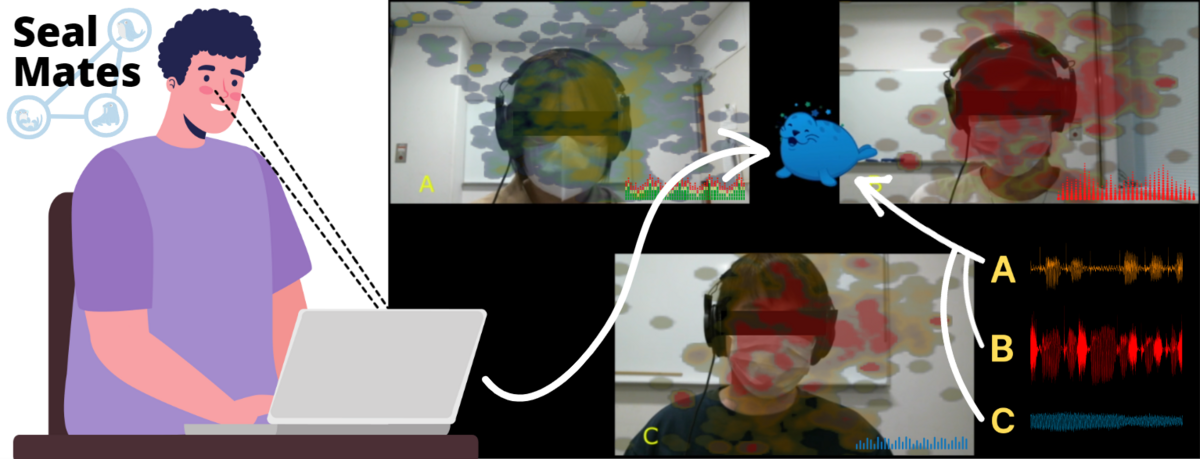
Instead of showing individual video feeds, SealMates represents the entire group through a shared animated avatar-an adorable seal that responds to collective behavioral cues:
Input Signals
- Voice activity - who's speaking, energy level, turn-taking patterns
- Audio features - tone, laughter, silence duration
- Participation patterns - engagement distribution across the group
Avatar Behaviors
The seal avatar expresses collective states:
- Active discussion → animated, playful movements
- Deep thinking/pause → calm, contemplative pose
- Excitement/agreement → bouncy, happy animations
- Awkward silence → fidgety, looking around
- Dominant speaker → attention directed that way
The Magic of "Collective"
What makes SealMates different from individual avatars is that it represents the group, not any single person. This creates shared ownership of the social space and encourages collaborative interaction.
What We Discovered
We deployed SealMates in real video calls and compared it to standard video conferencing:
Finding 1: Reduced Self-Consciousness
Without their faces on display, participants reported feeling less anxious about their appearance and more focused on the conversation. The constant self-monitoring that causes "Zoom fatigue" was significantly reduced.
Finding 2: Better Group Awareness
Surprisingly, participants felt more aware of the group's mood with SealMates than with standard video. The avatar made implicit group dynamics explicit and visible.
Finding 3: Equalized Participation
Introverted participants contributed more in the SealMates condition. The avatar provided a "safe" way to be present without the pressure of being visually on display.
Finding 4: It Was Fun
This might sound trivial, but it matters: people enjoyed using SealMates. They laughed. They commented on the seal's behavior. The playfulness changed the meeting's emotional tone.
Design Principles
Building SealMates taught us several principles for collective avatars:
1. Make the Collective Visible
Individual behavior is easy to see in video calls. Collective behavior isn't. Design should surface group-level patterns.
2. Abstract Without Losing Information
The seal avatar is highly abstracted, but it preserves the emotionally relevant information: energy, engagement, mood. Strip away the irrelevant, keep what matters.
3. Playfulness Serves a Purpose
Cute seals aren't just fun-they create psychological safety. People are more willing to experiment with interaction when the stakes feel lower.
4. Shared Ownership Changes Dynamics
When everyone shares an avatar, no one "owns" the visual space. This shifts dynamics from individual performance to collective expression.
Connection to My Research
SealMates connects directly to my PhD work on AI-augmented collaboration. CLARA helps groups through intelligent facilitation; SealMates helps groups through collective visualization.
Both are asking the same question: How can technology support group dynamics, not just individual communication?
📚 Personal Reflections: What I Learned
Groups Are More Than Individuals
So much collaboration technology focuses on individuals-your video, your audio, your screen share. SealMates reminded me that groups have emergent properties that deserve direct support.
Abstraction Can Increase Presence
It seems counterintuitive: replace HD video with a cartoon seal, and people feel more connected? But abstraction, done right, removes noise and amplifies signal.
Fun Is Functional
I used to think playfulness was separate from productivity. SealMates showed me they're intertwined. People do better work when they're enjoying themselves.
Small Changes, Big Effects
SealMates is technically simple-it's not using cutting-edge AI or complex rendering. But the behavioral and social effects were surprisingly large. Sometimes the best interventions are design insights, not technical feats.
What's Next
SealMates opens up questions about collective representation in remote communication:
- What other forms could collective avatars take?
- How do cultural differences affect collective visualization preferences?
- Can collective avatars support larger groups (10+)?
- How do we balance collective and individual representation?
The future of video calls might not be better video-it might be representations that capture what video can't.