
Making Virtual Meetings Actually Work
In simple terms: CLARA is like having a thoughtful meeting facilitator who can read the room-except it's AI, and it works in video calls. It watches for signs of confusion, fatigue, or disengagement and gently guides the conversation to keep everyone on track.
🎯 Key Takeaways
- 23% better task performance when CLARA facilitated meetings compared to regular video calls
- Reduced mental fatigue - participants felt less drained after AI-facilitated sessions
- Enhanced social presence - people felt more connected despite being remote
- Participants preferred it - given the choice, most wanted CLARA in their meetings
The Problem That Sparked This Research
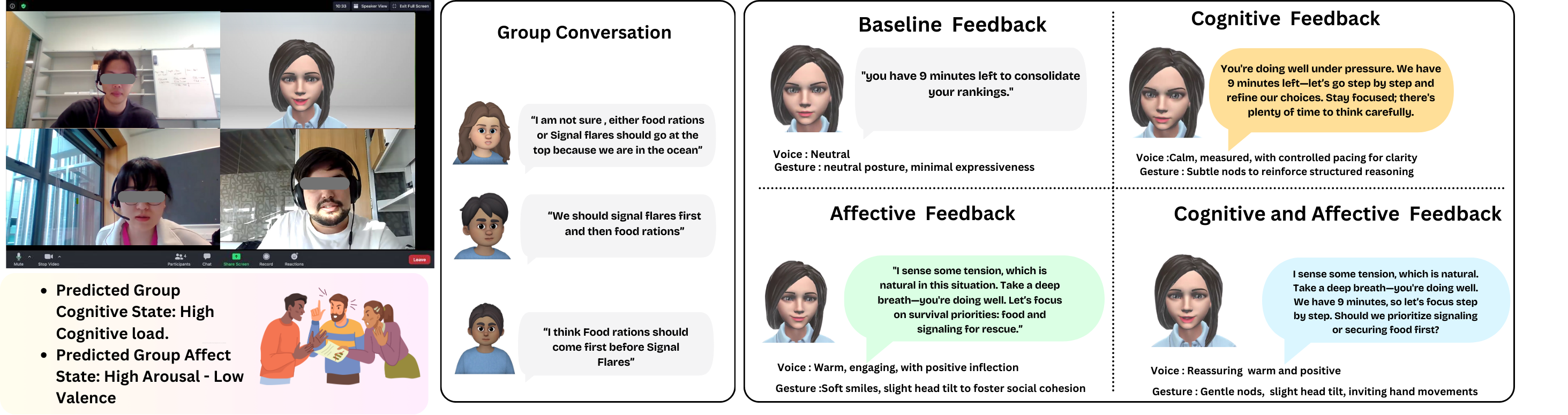
If you've spent any time in video calls over the past few years, you know the feeling. The meeting drags on. Someone's clearly checked out mentally. Another person is dominating the conversation. And you're exhausted before it even ends.
I started noticing this pattern during my PhD work on remote collaboration. We had all these sophisticated tools-HD video, screen sharing, virtual whiteboards-but something fundamental was missing. These tools were blind to how people were actually doing.
A skilled human facilitator would notice when energy was dropping and call for a break. They'd see when someone was trying to speak but kept getting interrupted. They'd sense when the group was spinning in circles. But our digital tools? They just kept streaming video, oblivious to the human dynamics unfolding.
What I Built
CLARA (short for Collaborative Learning and Reasoning Agent-yes, I'm a sucker for good acronyms) is my attempt to bridge this gap. It's an AI-mediated facilitator designed specifically for remote group work.
Here's what makes CLARA different from a typical AI assistant:
1. It Senses the Room
Using the multimodal sensing techniques I developed for CoAffinity, CLARA monitors:
- Facial expressions and gaze patterns (who's paying attention?)
- Voice patterns and turn-taking dynamics (who's dominating? who's silent?)
- Physiological signals when available (stress levels, cognitive load)
2. It Understands Context
CLARA doesn't just detect that someone looks confused-it understands why they might be confused based on what's being discussed. This context-awareness is crucial for meaningful intervention.
3. It Facilitates, Not Controls
This was perhaps the hardest design challenge. CLARA isn't there to run the meeting or make decisions. It's there to support human collaboration. Sometimes that means suggesting a quick break. Sometimes it means creating space for a quieter team member to contribute. Sometimes it means summarizing a complex discussion to ensure everyone's aligned.
The Technical Architecture
CLARA runs on three interconnected systems:
Sensing Layer: Captures multimodal data streams (video, audio, physiological when available) and processes them in real-time using lightweight ML models optimized for latency.
Understanding Layer: Combines individual signals into a group-level assessment. This is where the magic happens-transforming "Person A shows stress indicators, Person B appears disengaged" into "The group is experiencing decision fatigue after 40 minutes of debate."
Intervention Layer: Determines appropriate actions based on the group state and conversation context. Actions range from subtle (adjusting pacing) to explicit (suggesting a structured discussion format).
What I Learned From User Studies
I ran CLARA with real teams doing real collaborative tasks-not just lab scenarios, but actual problem-solving and decision-making sessions. Here's what surprised me:
People want facilitation, not surveillance. Early designs felt too "big brother" to participants. The breakthrough came when I framed CLARA as a facilitator joining the meeting, not a system monitoring them. Transparency and agency matter enormously.
Timing is everything. An intervention that's perfect at 30 minutes into a meeting is annoying at 10 minutes. CLARA learned to calibrate its interventions to the group's rhythm, not just their immediate state.
Different teams have different needs. Some teams thrived with more active facilitation; others wanted CLARA to stay mostly in the background. Building adaptability into the system was essential.
The Bigger Picture
CLARA represents a shift in how I think about AI and collaboration. The goal isn't to replace human connection-it's to remove the friction that prevents connection in digital spaces.
When I watch a well-facilitated meeting (human or AI), what strikes me is how much easier it becomes for people to do their best work together. Ideas flow more freely. Disagreements become productive rather than destructive. People leave feeling heard and aligned.
That's what I'm working toward: AI that makes human collaboration more human, not less.
What's Next
CLARA is published in ACM TOCHI, one of the premier journals in human-computer interaction. But this is just the beginning. I'm now exploring:
- How CLARA's facilitation style can adapt to different cultural contexts
- Integration with various video conferencing platforms
- Extending the approach to hybrid (in-person + remote) meetings
The future of work isn't about choosing between in-person and remote-it's about making every collaboration modality work better for humans.
📚 Personal Reflections: What I Learned
Building CLARA taught me that the hardest problems in HCI aren't technical-they're human. Getting the ML models to work was challenging, but getting the design right required understanding people at a much deeper level.
Three key learnings I carry forward:
- Technology should be humble. CLARA works best when it enhances human dynamics, not when it tries to replace human judgment.
- Context is everything. The same intervention can be helpful or harmful depending on timing, team dynamics, and conversation state. Building systems that understand context is hard but essential.
- Collaboration is sacred. When people come together to think and create, there's something almost magical happening. Our job as technologists is to protect and enhance that magic, not disrupt it.
This project reminded me why I fell in love with HCI research in the first place: the opportunity to make technology serve human flourishing.